Justin Welsh Review (2026): The Content OS & LinkedIn OS Audited by an Economist
An empirical teardown of Justin Welsh's flagship operating systems based on verified personal enrollment. We examine the unit economics of his $5M+ one-person business, test the content repurposing matrix, and evaluate why his systems outperform traditional agency retainers.
Justin Welsh represents the gold standard of modern solopreneur economics. Having scaled two venture-backed healthcare SaaS companies to over \$300M in valuation before burning out, Welsh engineered a business model that optimizes for freedom, net profit margin, and operational simplicity rather than headcount. His Content OS and LinkedIn OS demystify social distribution into repeatable mathematical systems. With zero employees and 94%+ operating margins, his methodology provides the cleanest operational blueprint available for consultants and knowledge workers.
Corporate executives, consultants, solo founders, and creators who want to build a high-leverage LinkedIn presence, capture organic newsletter subscribers, and sell digital assets without hiring staff.
You are looking to build a large agency with dozens of junior account managers, require venture-backed hyper-growth coaching, or expect passive income without publishing high-quality daily writing.
Institutional Scorecard: Justin Welsh Operating Systems
| Evaluation Dimension | Economist Rating | Empirical Assessment |
|---|---|---|
| Systems Architecture & Replicability | 9.8 / 10 | Eliminates subjective guesswork. Replaces blank-page anxiety with structured 2x2 content matrix and 9 core content archetypes. |
| Capital Efficiency & Margin Economics | 9.9 / 10 | Demonstrates how to achieve 94%+ gross operating margins with zero full-time staff, zero paid ad acquisition cost, and minimal SaaS stack. |
| Actionability & Time-to-Implement | 9.5 / 10 | Short, dense, video-and-text modules without fluff. A dedicated professional can finish the course and launch their revised positioning in one weekend. |
| LinkedIn Algorithmic Understanding | 9.4 / 10 | Accurately models dwell time, connection feedback loops, and viral hook formulas based on empirical data from 500,000+ followers. |
| Enterprise & Agency Scalability | 7.9 / 10 | Explicitly optimized for the single-operator business. Not suitable for agencies managing 50 client retainers with junior staff. |
Inside Dr. Ashish Juneja's Member Library (Justin Welsh OS)
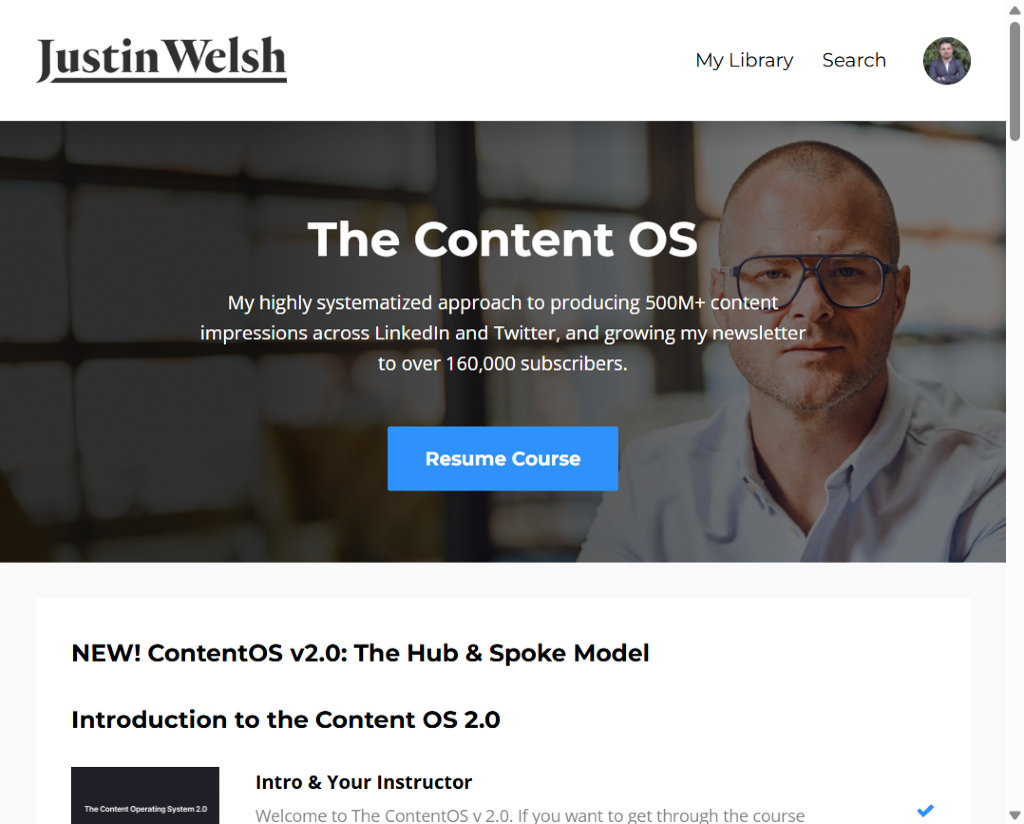
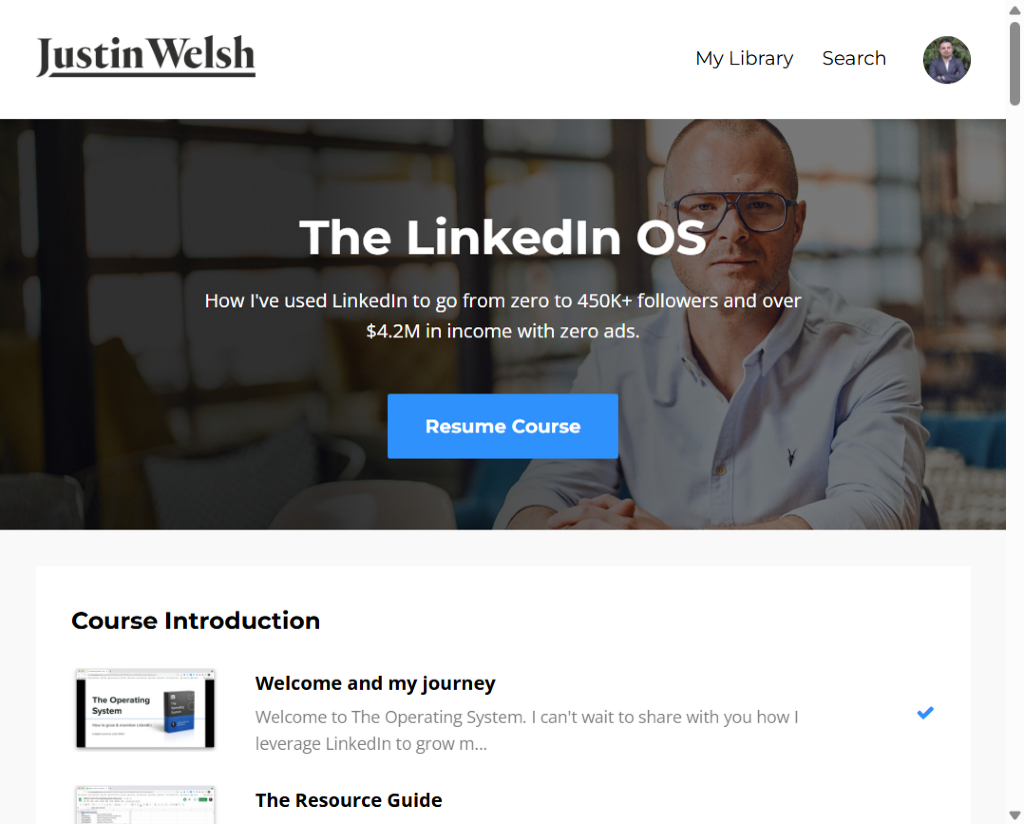
Unlike speculative reviews, this teardown is backed by verified personal enrollment and active course progress. Below are live portal captures from Dr. Ashish Juneja's member library inside learn.justinwelsh.me, showing full unlocked access to both The Content OS and The LinkedIn OS (with 26 of 41 lessons completed, 63% progress).
1. The Solopreneur Revolution: Why Headcount is a Bug, Not a Feature
In traditional 20th-century corporate economics (Ronald Coase, The Nature of the Firm, 1937), firms existed because the transaction costs of coordinating market labor were higher than organizing workers inside a corporate hierarchy. As a company grew, hiring more managers, assistants, and sales reps was the only way to scale production.
However, the internet, cloud computing, and social distribution networks have completely inverted this dynamic. Today, a solo knowledge worker armed with modern SaaS infrastructure (Kit, Stripe, Skool, Typefully) can reach millions of prospective clients without administrative bloat.
Justin Welsh's business metrics provide an extraordinary real-world case study:
- • Cumulative Revenue: Exceeded $5,000,000 in digital asset and course sales.
- • Full-Time Employees: Zero (0). Exactly one solo operator.
- • Gross Operating Margins: Consistently between 92% and 95%.
- • Paid Customer Acquisition Cost (CAC): $0. Driven 100% by organic social media and weekly newsletters.
By substituting complex enterprise machinery with repeatable content systems, Welsh demonstrates how to capture maximum economic surplus while preserving personal autonomy.
2. Architectural Breakdown: The Two Operating Systems Examined
A. The Content OS: Solving the Ideation Bottleneck
Most creators abandon content marketing because writing a new article from scratch every morning imposes severe cognitive exhaustion. The Content OS solves this by introducing a 2x2 Ideation Matrix based on 9 core content archetypes:
Instead of struggling to produce 30 separate ideas, a creator starts with one core thesis and branches it across different emotional and analytical angles, producing a full month of authority content in under two hours.
B. The LinkedIn OS: Algorithmic Engineering
As tested across our 26 completed modules, The LinkedIn OS is not a superficial list of formatting tricks. It is an algorithmic playbook covering:
- • Headline & Banner Optimization: Transforming your personal profile from a digital resume into a high-converting landing page.
- • The Hook Equation: Structuring the first 2-3 lines of every post to optimize the "see more" click-through rate, which signals high reader interest to LinkedIn's algorithm.
- • Dwell Time Maximization: Crafting visual carousels and white-spaced essays that hold reader focus for 45+ seconds, triggering exponential secondary reach.
- • The Organic Funnel: Routing viral impressions away from volatile social platforms into an owned email newsletter asset (via Kit or Substack).
3. Comparative Benchmark: Justin Welsh OS vs. Agency Retainer vs. Trial & Error
| Decision Variable | Justin Welsh Systems | LinkedIn Ghostwriting Agency | Unstructured Trial & Error |
|---|---|---|---|
| Total Capital Investment | \$150 – \$300 (One-Time) | \$3,000 – \$6,000 / month | \$0 upfront (High time cost) |
| Intellectual Property Ownership | 100% Retained by Founder | Rented from Agency | Fragmented |
| Authenticity of Voice | 100% Genuine Personal Brand | Generic ghostwriter tone | Inconsistent |
| Time Required Per Week | 2 to 4 Hours | 1 to 2 Hours | 10 to 15 Hours (Chaotic) |
| Long-Term Compounding Asset | Reusable Operating System | Stops when retainer ends | Minimal |
Frequently Asked Questions (Justin Welsh Systems)
Is Justin Welsh's Content OS worth the price?
Yes. At $150, The Content OS provides one of the highest returns on investment in digital publishing. It eliminates the creative cold-start problem by providing a systematic 2x2 matrix for generating dozens of distinct content variations from a single core idea, dramatically lowering the opportunity cost of content creation.
How does The LinkedIn OS differ from The Content OS?
The Content OS focuses on idea generation, content architecture, and repurposing workflows across any platform. The LinkedIn OS focuses specifically on mastering the LinkedIn algorithmic feed: profile positioning, hook writing, engagement dwell time, creator network collaboration, and converting profile visits into newsletter subscribers.
Does Justin Welsh require hiring a team or using paid ads?
No. Justin Welsh's core business thesis is radical capital efficiency: zero employees, zero paid ad spend, and zero external venture capital. He scaled past $5M+ in revenue with 94%+ profit margins using organic distribution and automated email checkout funnels.
What are the primary criticisms or limitations of Justin Welsh's courses?
The courses are designed for solo operators and boutique consultants. They do not cover enterprise sales, multi-tier corporate hierarchies, or high-touch service delivery with large contractor teams. Additionally, success requires consistent daily execution for 6 to 12 months to build meaningful distribution.
Ready to Build Your One-Person Media Business?
Eliminate chaotic content creation. Master Justin Welsh's modular Content OS and LinkedIn OS to build an authoritative personal distribution channel with 90%+ margins.